Installation series (2026-)
MEMORY
When I was five years old, my grandmother took me for a walk in the woods on Runmarö – an island in the Stockholm archipelago. She showed me a long stone wall and where to find chanterelles beside it; she pointed out where “the angry man” lived—a man who had once scolded her for picking blueberries on what was apparently his land; and, most importantly, she showed me the flooded quartz mine.
The bedrock emerged directly at the surface, creating a natural clearing in the dense forest. White and pinkish quartz stones lay scattered across the ground around us. To a five-year-old, it felt like stepping straight into a treasure chamber. The water-filled mine shaft was hidden behind a small hill—probably a mound of excavated earth, overgrown with moss and underbrush over the centuries. I was not allowed to go too close to the edge. My grandmother explained how extraordinarily deep it was.
“How deep?” I asked.
“So deep you cannot imagine it,” she replied.
She handed me a sparkling pink stone and asked me to throw it back into the mine. It felt wrong to part with it, but she assured me there were plenty more. The mirror-like surface broke apart, and the reflection of forest, sky, and blueberry shrubs dissolved into a rippling blur. We stood watching as the rings slowly expanded, faded, and disappeared.
My grandmother gave me another quartz stone to bring, and we began what felt like a long journey to a five-year-old. After half an hour or so, we reached the final winding gravel road leading back to our house.
“Now,” my grandmother suddenly said. “Now the stone has reached the bottom of the mine. That’s how deep it is.”
The thought was dizzying. It was as though I were seeing stars.
THE SUBLIME
Looking back, I realize that the landscape of my childhood was never simply natural. The stone wall, the property boundary, the gravel road, the abandoned mine: all were products of human touch. History had become indistinguishable from nature itself.
Our stroll in the woods passed through a landscape shaped by extraction, ownership, labour, and time—a forest saturated with history. But to me everything seemed like nature: an eternal entity. I think of that time, looking down onto the mirror surface of the black water filled mine pit, as my first sublime experience.
For me, and for many Swedes, the forest has always exerted an almost religious influence, shaped more by reverence than by a desire to tame. At the same time, the taming of nature has constituted a religious theme since time immemorial.
For centuries, the garden served as the quintessential expression of humanity’s ordering hand. Etymologically, the word paradise derives from an ancient Persian term meaning “enclosed garden.” With pruned trees, laid-out paths, and strict borders, the paradise garden moves toward culture. This formulation of Paradise presupposes an outside. The garden wall separates order from wilderness, safety from danger. But what happens when there is no longer an outside to exclude?
In the Anthropocene, these boundaries have dissolved entirely. Once the garden reaches a planetary scale, enclosure loses its function. If there is no longer any outside, enclosure becomes a peculiar gesture. It no longer protects from the world; it merely frames what is already inseparable from it.
INSTALLATION
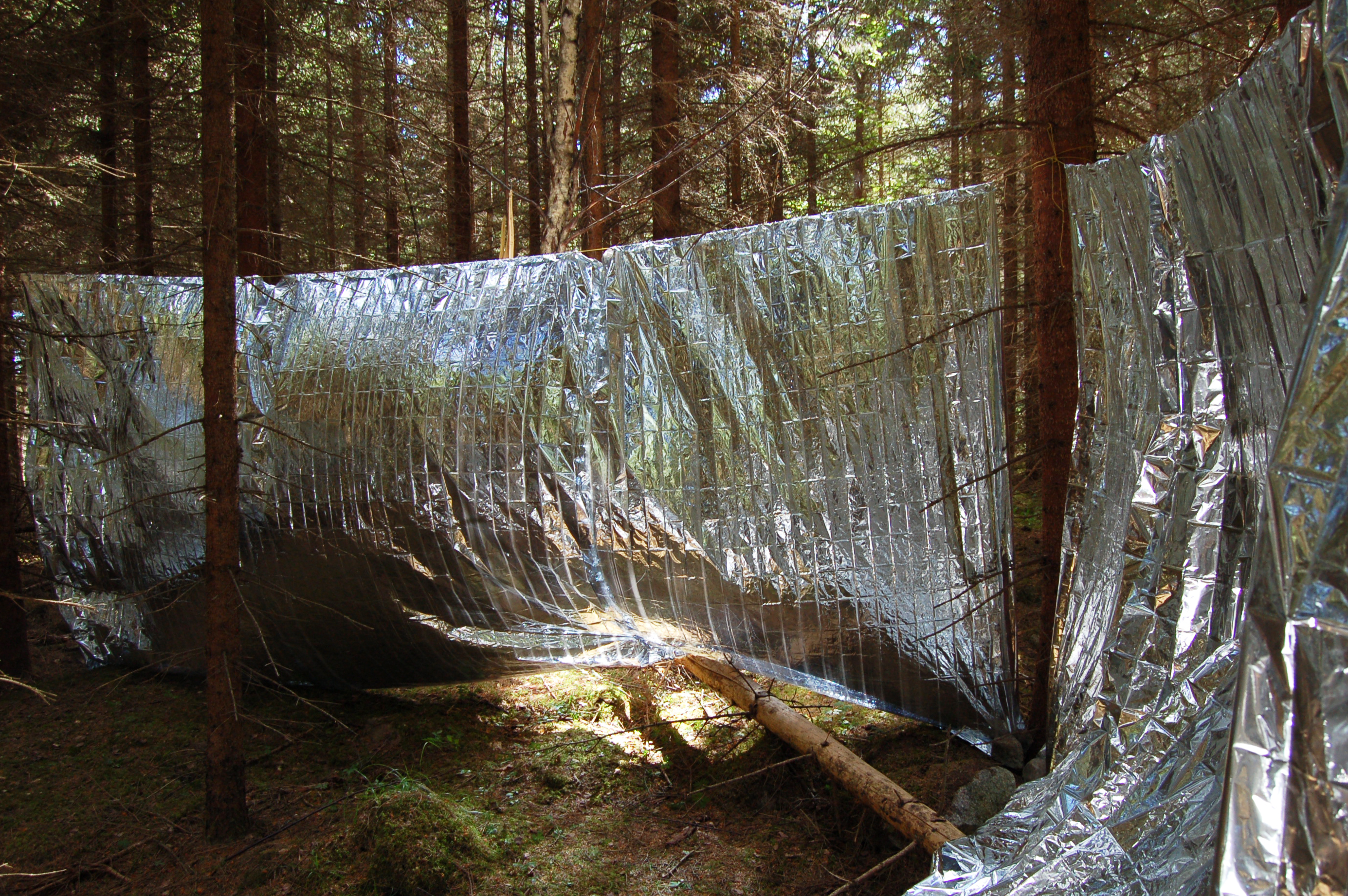
Losing My Religion consists of a series of temporary enclosures constructed from foil emergency blankets suspended between trees. Their form derives from the quadrat, a square frame used in ecology, geography, and biology to isolate a fragment of a larger environment for observation and analysis.
Enclosure elevates nature into paradise, yet in doing so it also brings it back down to the very earth that humanity’s ordering hand is in the process of destroying. Rather than protecting nature, the works expose the difficulty of locating it. They mirror the distorted image of nature inherent in every attempt to define it: a shifting boundary between nature, culture, labour, memory, and belief.
The emergency blanket introduces another layer of ambiguity. Designed to preserve life in moments of crisis, it implies danger, rescue, and survival. Yet what exactly is being rescued remains unclear. The forest? An idea of nature? A childhood experience? The possibility of an outside?
The installations revisit the ancient gesture of enclosure without fully believing in it. Their reflective surfaces simultaneously separate and mirror their surroundings. The forest appears both contained and impossible to contain as interior and exterior collapse into one another. Like the surface of the flooded mine, the installations create a fragile boundary that appears momentarily stable before dissolving back into its surroundings.